
How commerce and IT leads on SAP Commerce Cloud can use custom Joule skills and API actions to answer order, product and shipment questions, and what to set up first.
Overview
-
Custom API integration. Connect Joule to catalog, inventory, and order data through authenticated commerce APIs exposed as actions.
-
Conversational assistance. How to quickly resolve questions such as “Is SKU ABC-123 in stock?” or “What is the status of order 4567?” using live backend responses.
-
Evidence-based diagnostics. Combine authorized order records, shipment information, and diagnostic data to suggest likely causes and next steps.
Why commerce questions need an agent
Order processing, inventory management, and customer support depend on multiple systems. When an item is unavailable, or an order is delayed, teams often need to retrieve and reconcile information from several APIs. This article describes a custom integration approach that uses SAP Joule to coordinate those lookups and present a single, contextual response. Availability of standard capabilities should be checked for the target product edition and tenant; the design here does not depend on a prebuilt Commerce skill.
Skills as the Building Blocks
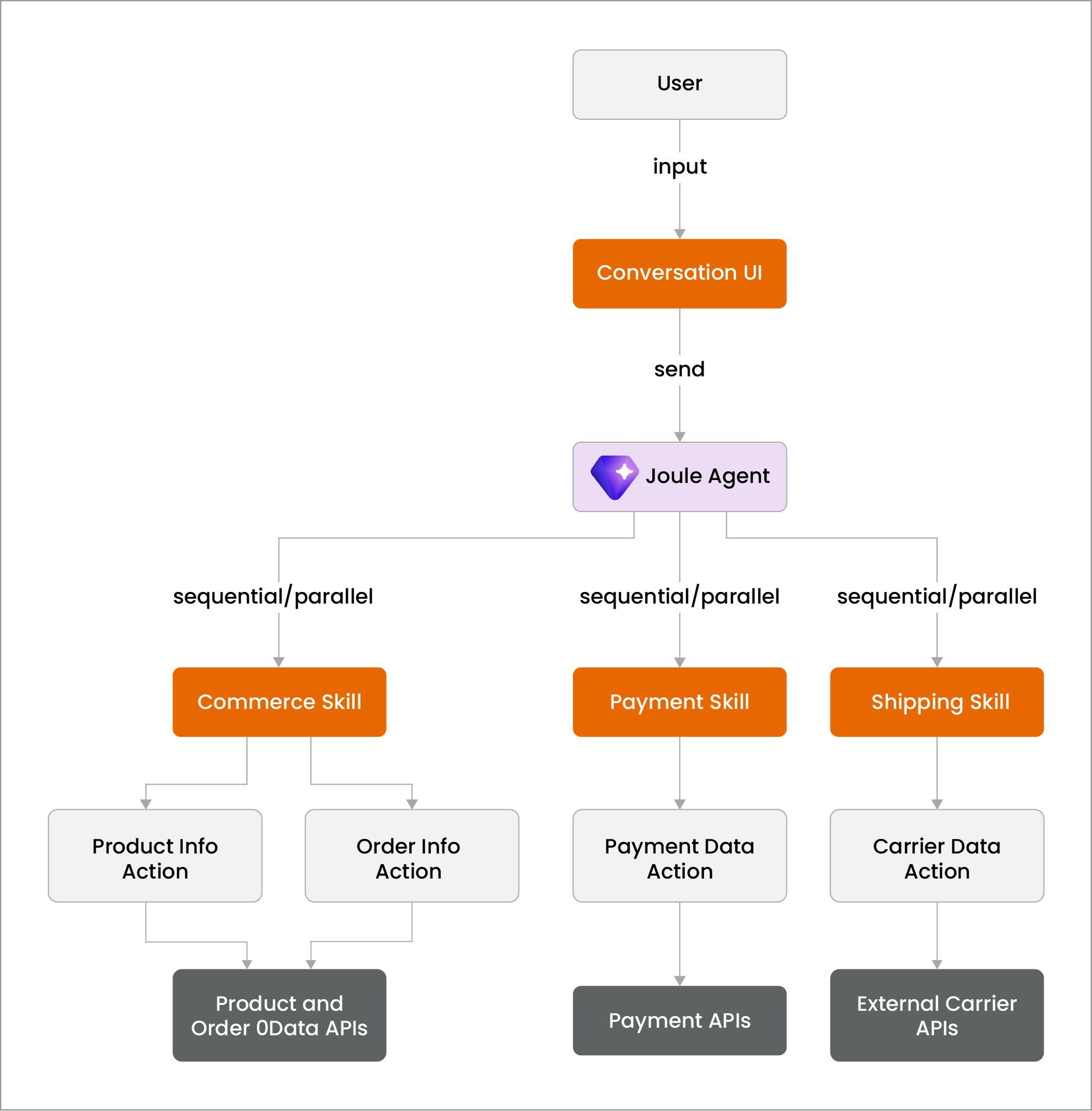
At the heart of the agentic approach are Skills: lightweight, purpose built modules that encapsulate a single capability such as “check SKU availability,” “retrieve order status,” or “summarize sales performance.” An agent can invoke one or many Skills—sequentially or in parallel—and then aggregate, filter, or transform the results before delivering a polished response. Because SAP Joule offers no out‑of‑the‑box Commerce Cloud skill, organizations typically craft custom Skills that wrap Commerce Cloud’s REST endpoints and enrich the data with business rules, ensuring the agent can speak the platform’s language.
LLM-driven orchestration
An LLM reads the user’s intent and picks the tools. Instructions, validated inputs and backend business rules limit what it can do, and the agent’s configuration can cap concurrent calls. Independent lookups can run in parallel where supported. Dependent ones stay in sequence, such as retrieving an order before looking up its product codes. Fallback behavior should tell missing data, API failures and ambiguous requests apart.
Let the agent coordinate the conversation; let authenticated APIs and business rules determine what it can read or change.
Four commerce use cases for a Joule assistant
The examples below are illustrative scenarios, not customer case studies.
1. Product enrichment
What it does. Produces draft product content for multiple channels and languages.
How it works. A product-enrichment skill retrieves verified SKU specifications and generates SEO-friendly titles, three-sentence product summaries, attribute lists, and localized translations.
Illustrative scenario. A consumer-electronics retailer prepares German, English, and Spanish content for a large catalog launch. The skill accelerates drafting, while reviewers validate specifications, translations, and required disclosures before publication.
The retailer examples in this article are illustrative, not verified case studies. The original draft’s numerical outcome claims require supporting sources before publication.
Key considerations
- Speed. Batch generation can reduce drafting effort; throughput depends on model limits and review requirements.
- Consistency. Shared templates support a common tone, but generated content still needs quality checks.
- Compliance. Include required statements and obtain appropriate review before publishing.
2. Agentic Order Creation (Shop‑on‑Chat)
What it does. Supports conversational cart management and checkout.
How it works. A cart skill converts “Add three X-Series tablets to my cart” into validated API inputs. Checkout actions retrieve backend-calculated promotions, taxes, and totals. The assistant presents the order for explicit user confirmation and submits it only through the authorized checkout workflow.
Illustrative scenario. A retailer adds chat-based checkout to its mobile experience. Customers review items and eligible add-ons without navigating multiple screens. Adoption and order-value changes should be measured rather than assumed.
3. Agentic Order Fulfillment & Real‑Time Visibility
What it does. Provides shipment visibility and proactive delivery updates.
How it works. A shipment-status skill retrieves available order, consignment, and carrier data through configured APIs. The LLM summarizes the latest status and estimated arrival time. A separate notification workflow sends permitted email or in-app updates.
Illustrative scenario. An electronics distributor uses the same status lookup for customer self-service and support staff, reducing duplicate manual checks and improving visibility into delivery exceptions.
Key considerations
-
Transparency. Show the latest available delivery estimate and tracking information; do not present estimates as guarantees.
- Automation. Routine status checks can be handled without manual lookup when data is available.
- Exception handling. Escalate delays and offer policy-approved alternatives through the relevant fulfillment workflow.
4. Order troubleshooting
What it does. Guides customers and support staff through order issues.
How it works. A troubleshooting skill investigates a complaint such as “I never received my 3D printer” by comparing order and shipment records. The agent explains likely causes supported by those records and proposes policy-approved options, such as a replacement or refund. A missing delivery scan alone is not proof that a package was lost.
Illustrative scenario. A toy retailer combines order lookup, shipment checks, and escalation in one conversation. Unresolved cases reach a human support representative with the relevant evidence attached.
Key considerations
-
Context awareness. Retain authorized session context so customers do not need to repeat details unnecessarily.
-
Escalation readiness. Route uncertain or policy-sensitive cases to a human representative.
-
Controlled changes. Refunds and replacements require backend authorization and applicable approvals.
Extended Agentic Use‑Cases (Beyond the Core)
| Scenario | Integration approach |
|---|---|
| Pricing and discounts | A pricing skill retrieves approved pricing and inventory inputs, proposes changes within business constraints, and explains authorized promotions. Price updates require governed backend workflows. |
| Upselling and cross-selling | A recommendation skill analyzes permitted cart and purchase information to suggest relevant add-ons and eligible offers. |
| Privacy and compliance checks | A policy-checking workflow enforces configured consent, access, and data-minimization rules. Automated checks support, but do not guarantee, legal compliance. |
| Returns and exchanges | A return skill initiates authorized return requests, retrieves shipping labels, and updates return status. Inventory changes follow the established receipt and inspection process. |
Implementation: How Joule skills connect to SAP Commerce Cloud APIs
It is worth mentioning that Joule doesn’t include prebuilt scenarios or artefacts for connecting to SAP Commerce Cloud. Instead, we’ll be leveraging the existing Commerce Cloud OData APIs in the custom Joule Skills to perform the relevant searches and operation.
Joule skills can connect to SAP and third-party systems through configured API actions. For this design, the backend integration exposes only the commerce operations required by the assistant.
A skill is a defined workflow, not necessarily a standalone REST or gRPC service. It can invoke actions, map parameters, apply conditions, and process responses. The agent coordinates these capabilities to answer requests that span more than one backend operation.
Detailed skill-development practices are beyond the scope of this article; I plan to explore them in future publications.
Create an API action for each required remote operation, with explicit input and output parameters. Test and publish the action before adding it to a skill.
Actions provide deterministic execution. SAP Build action projects define structured operations such as GET, POST, and PATCH. Joule skills consume these actions to retrieve records or invoke business workflows. Backend authorization and validation remain responsible for enforcing what each operation is allowed to do.
Example: an order and product assistant
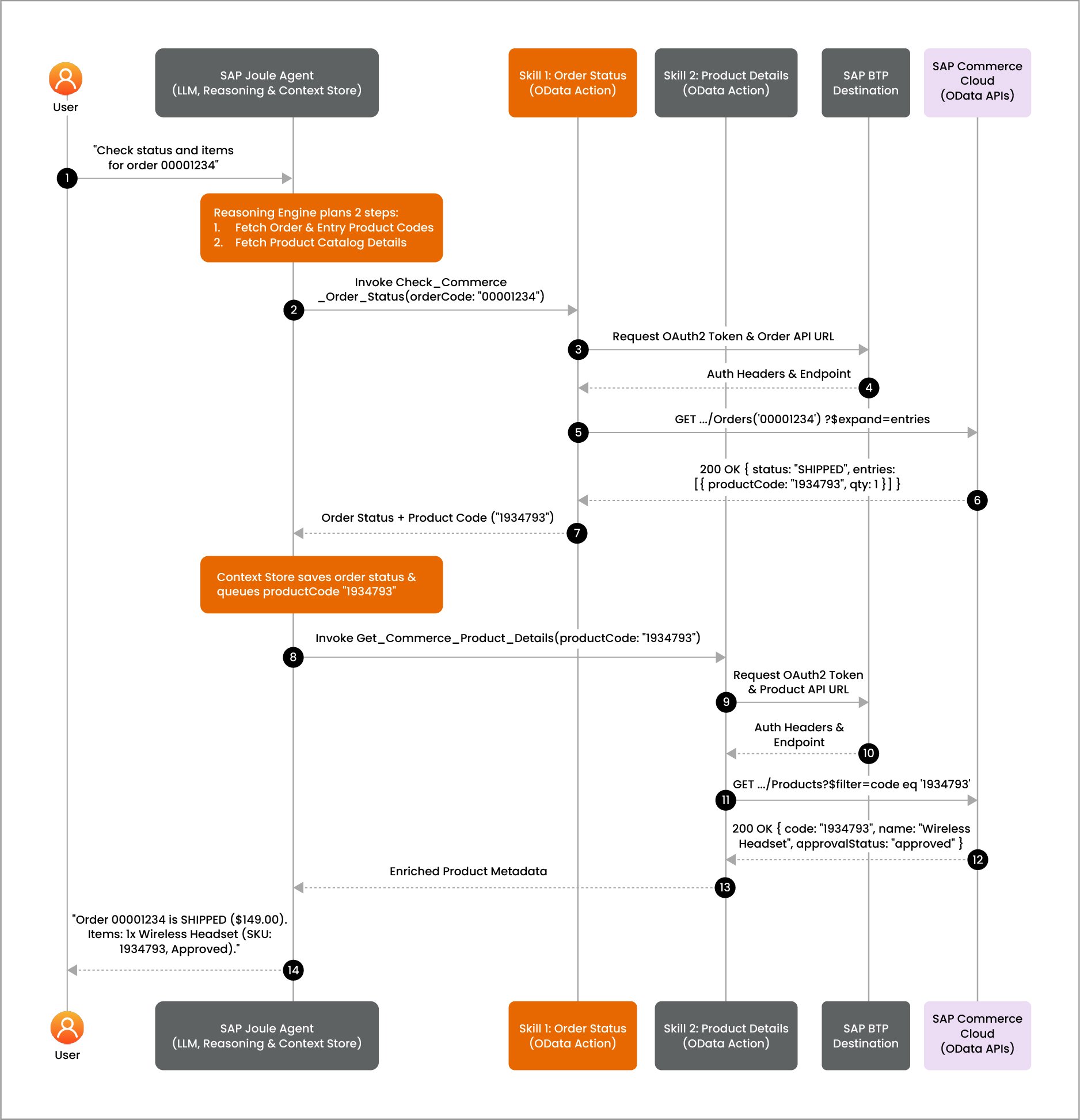
Take a read-only assistant that answers an order-status question and adds product details to each line item. It retrieves the order first, then uses the returned product codes to request catalog details. The reasoning and context layers described here are conceptual roles, not SAP component names.
Agent configuration
-
Agent name: Commerce_Order_And_Product_Assistant.
-
Description: Retrieves authorized commerce order and product information.
-
Expertise and instructions: Retrieve the order’s current fulfillment status and enrich its line items with catalog details. Ask for missing identifiers, report unavailable data, and do not change the order.
-
Order skill: Check_Commerce_Order_Status retrieves the order header, status, and line-item product codes.
-
Product skill: Get_Commerce_Product_Details retrieves product names and permitted catalog metadata.
-
Session context: Preserve orderCode, product codes, product categories, quantities, and retrieved metadata only for the authorized workflow.
Orchestrated OData actions
Environment-dependent examples. The service names below come from the proposed design. Confirm that the Integration Objects expose these entity sets and properties in the target environment. A single-entity lookup may require an integration key rather than the order code. Validate query options and navigation paths against the service metadata.
Step 1: retrieve the order
Action: SAP_Commerce_Order_OData
GET /odata2webservices/InboundOrder/Orders?$filter=code eq '4567'&$expand=entries
Expected data: The order status, total, line-item quantities, and product codes exposed by the Integration Object. A sample response might contain a shipped order totaling $149.00 and product code 1934793; these values are illustrative.
Step 2: retrieve product details
Action: SAP_Commerce_Product_OData
GET /odata2webservices/OutboundProduct/Products?$filter=code eq'1934793'&$expand=supercategories
Expected data: The product name and permitted catalog metadata. Include catalog and version constraints when product codes are not unique across catalogs. Approval status and other internal attributes should be exposed only to authorized users.
Bind validated action parameters rather than concatenating untrusted prompt text into a query. The displayed requests are illustrative layouts, not confirmed production-ready endpoints.
- Endpoint. GET /odata2webservices/OutboundProduct/Products?$filter=code eq '{productCode}'&$select=code,name,approvalStatus,catalogVersion
-
Result. Returns the catalog details (Wireless Headset, Approved) for each product code found in the order entries.
Agent execution flow
-
Interpret and plan. Identify the order-status request, obtain any missing identifier, and verify that the user is authorized to access the order.
-
Retrieve the order. Invoke the order action through the configured destination and retain the returned line-item identifiers.
-
Iterate the items. Invoke the product action for the distinct product codes, applying catalog constraints and limits on calls.
-
Summarize the evidence. Combine the returned data into an order summary and identify any missing or failed lookups.
The final response should clearly separate fulfillment status, product details, and any delivery estimate. If an API fails or data is incomplete, report that limitation rather than filling the gap with a generated answer.
SAP Commerce implementation considerations
-
Configure an SAP BTP destination for the target SAP Commerce Cloud API environment, including the base URL and supported authentication settings. Define the service resource path at the action-project level where appropriate and verify how it combines with the destination URL. Restrict backend permissions to the required operations and records.
-
Use the service’s EDMX metadata or an available OData destination to create the action project, depending on the supported API-source options in the target edition. Validate entity sets, keys, navigation properties, and query options against the actual service. A shared destination can be reused only when its base URL, authentication, and resource-path configuration are compatible with each service.
-
Model purpose-specific Commerce Integration Objects that expose only the required data. Smaller payloads reduce unnecessary context consumption and can improve response latency. Measure performance with representative orders, and test missing products, multiple catalog versions, authorization failures, and partial API responses before deployment.
Start with read-only lookups
A commerce assistant works best when conversational reasoning sits on top of narrow, well-tested API capabilities. Start with read-only order and product lookups, validate what comes back, and measure reliability before moving to transactional workflows. The same integration pattern carries over to the use cases above.