Knack Systems breaks down SAP's 2026 CX roadmap — separating production-ready capabilities from roadmap promises, with a phased action plan for B2B teams.
Why Change? Why Now?
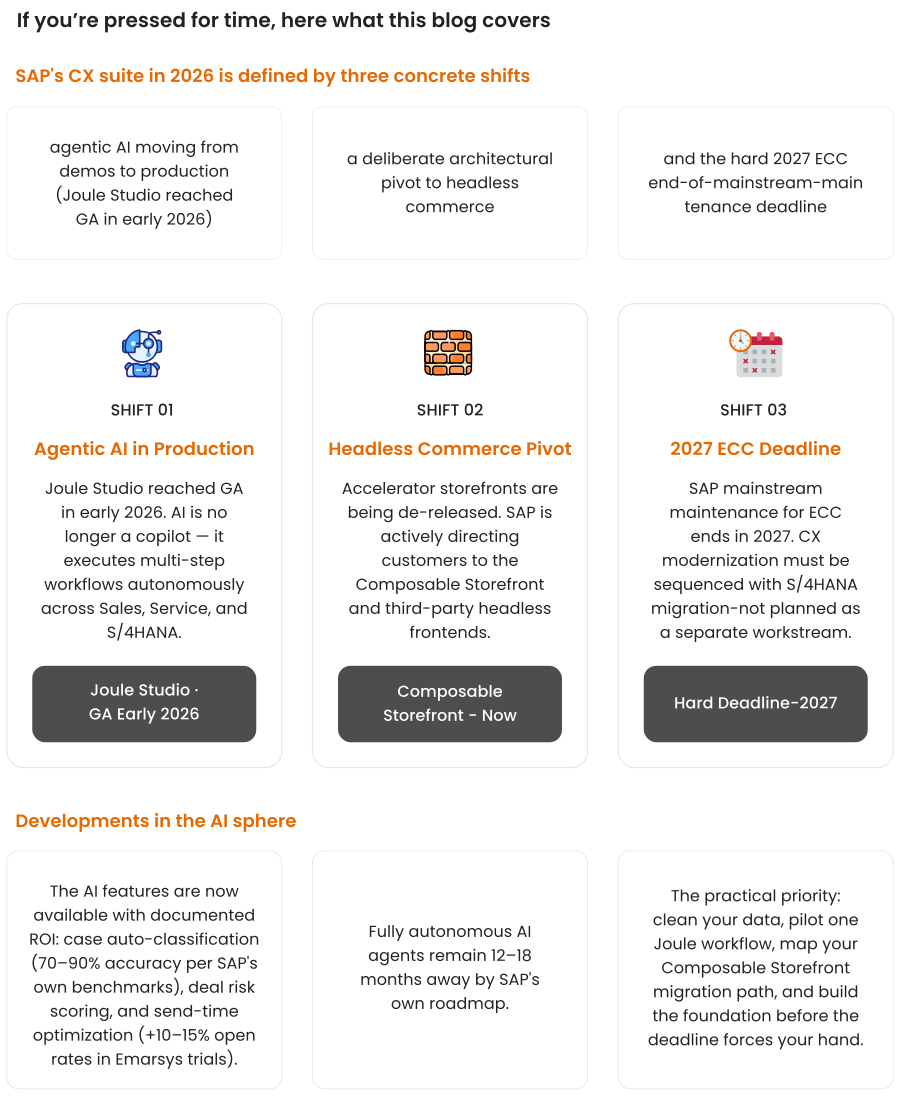
SAP's strategic direction has hardened considerably since 2023. The shift to S/4HANA and cloud-native operating models is no longer optional positioning, it is reflected in SAP's published support lifecycle policies and product investment patterns.
For B2B organizations, three structural realities follow from this:
ECC end-of-mainstream-maintenance is a fixed date. SAP has confirmed that mainstream maintenance for ECC ends in 2027 (with extended maintenance options available at additional cost through 2030). Organizations that haven't begun S/4HANA scoping are compressing their runway. Critically, CX modernization decisions made in isolation from ERP migration planning create integration debt that compounds over time.
AI is now a platform layer, not a bolt-on. SAP reports over 350 AI features and more than 2,400 Joule skills across its cloud portfolio as of early 2026. Within the CX-specific footprint, approximately 20–25 features are generally available; another 10–15 are in limited preview or on the published roadmap. The distinction matters: production-ready and roadmap features are not the same investment risk.
Vertical specificity is becoming a competitive differentiator. SAP's increased emphasis on industry-cloud solutions means B2B companies in manufacturing, distribution, and high-tech can access pre-configured templates and process accelerators that materially shorten time-to-value versus horizontal deployments.
Agentic AI: The Defining Theme of 2026
If one theme dominates SAP's published CX roadmap for 2026, it is the shift from AI that assists to AI that acts: what SAP and the broader market are calling agentic AI. SAP's Q4 2025 release introduced out-of-the-box agents for customer service scenarios and the Joule Studio agent-building environment. Joule Studio reached general availability in early 2026.
What Joule Studio Actually Does
Before Joule Studio, Joule functioned as a reactive copilot: you asked, it answered. Joule Studio changes the interaction model. You build custom AI agents that execute multi-step workflows autonomously, connecting Sales Cloud V2, S/4HANA, third-party systems, and external data sources within a single orchestrated flow, without requiring custom integration code for each handoff.
Documented use cases from SAP's partner ecosystem and early adopters include:
-
Pre-call briefing agents that pull historical purchase records, open opportunities, and recent service interactions before a rep's scheduled call, reducing manual prep time by an estimated 15–20 minutes per interaction.
-
Warranty-check bots that query S/4HANA inventory and entitlement records before a human agent touches a service case, eliminating manual lookup on routine inquiries.
- Delivery timeline agents that monitor logistics data feeds and proactively notify stakeholders about delays, shifting the communication model from reactive to anticipatory.
These are documented implementations. Results will vary depending on data quality, configuration, and process maturity.
What's Production-Ready vs. What's Still Coming
One of the most important distinctions when evaluating any CX vendor's AI narrative is separating what is in production from what is on a slide. Here is an honest assessment based on SAP's published release notes and publicly available partner case studies:
| Production-ready now | Limited preview | On the roadmap |
|---|---|---|
| Joule conversational assistant in Sales Cloud V2 | Agentic lead qualification in Sales Cloud V2 | Autonomous deal progression |
| Auto case classification in Service V2 (70–90% accuracy) | Joule Studio agent builder (GA early 2026) | Autonomous campaign optimization |
| Sentiment analysis & ML-based case routing | Predictive CLV in CDP | Full autonomous case resolution |
| Send time optimization in Emarsys (+10–15% open rates) | AI-powered report builder in Emarsys | Agent-to-Agent (A2A) interoperability |
| AI content generation for campaigns | Intelligent audience building in CDP | Cross-channel journey optimization |
Product-by-Product: What's Changing
SAP is consolidating around a coherent architectural thesis: AI-orchestrated workflows running on BTP, unified customer data flowing between S/4HANA and the CX layer, and frontends that are composable rather than monolithic. For B2B organizations, the implication is that decisions made in one product area, say your Commerce storefront architecture, will constrain or enable what you can do in adjacent areas like service automation or CDP segmentation. This is no longer a portfolio of loosely connected point solutions. The integration depth is real, and the companies that will extract disproportionate value are those that plan across the suite rather than optimizing each product in isolation.
SAP Commerce Cloud: The Headless Pivot
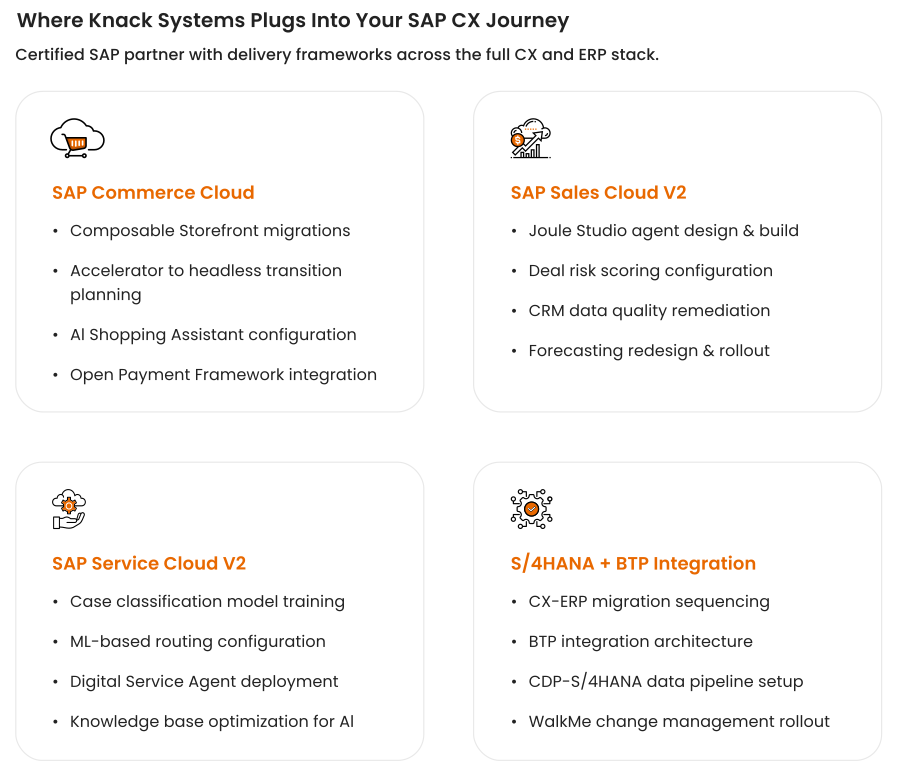
The most consequential architectural shift in Commerce Cloud is the de-release of Accelerator storefronts, SAP's legacy monolithic frontend framework, in favor of headless and composable architectures. SAP is guiding existing Accelerator customers toward the Composable Storefront (formerly Spartacus) or third-party headless frontends via documented API layers.
“If your B2B storefront runs on Accelerator today, you have a migration decision to make, and the sooner you scope it, the more control you have over timing and cost.- Viral Doshi, Senior Technical Consultant at Knack Systems.
Three notable additions in 2025–2026:
AI Shopping Assistant (available via the CX AI Toolkit): Enables conversational product discovery through natural language queries, spec comparisons, and AI-generated recommendations. Multi-language support is built in. Relevant for B2B catalogs with high SKU complexity where search-and-filter UX historically underperforms.
Storefront MCP Server (Q2 2026 target): Allows AI agents to discover products and execute transactions programmatically, without a traditional storefront interface. The practical implication is that B2B procurement systems and AI agents could interact directly with your catalog via structured protocols. This is worth tracking even if you're not implementing it yet.
Open Payment Framework: No-code payment provider integration supporting Stripe, Adyen, Worldpay, Airwallex, and custom PSPs. Natively supports B2B account-based payments and offline settlement. Included at no additional license cost with existing Commerce Cloud contracts on version 2211.35 or later.
SAP Sales Cloud V2: Intelligence Meets Execution
Sales Cloud V2 received its most substantive AI update to date in early 2026. Three capabilities are worth noting for B2B sales organizations:
Joule Studio (GA): As described above, this moves AI from suggestion to execution. For sales teams, the highest-value starting point is typically a contained workflow — pre-call briefing, post-call summary, or CRM data hygiene — before expanding to more complex multi-system automations.
Activity-based deal risk scoring: The system monitors engagement signals across email, calendar, and CRM activity, then flags specific risk patterns. No customer contact on a deal for 14 days when it's marked closing this quarter? Surfaced. Primary stakeholder hasn't engaged with your last three touchpoints? Flagged. This is behavioral pattern detection applied to pipeline management (more specific than traditional forecast categories).
Redesigned forecasting: Multi-level drill-down from pipeline totals through team rollups to individual opportunities, without the context switches that characterized the previous interface. SAP reports over 30 AI capabilities across machine learning, predictive scoring, and generative productivity within Sales Cloud V2 as of early 2026.
SAP Service Cloud V2: The Strongest Near-Term ROI Case
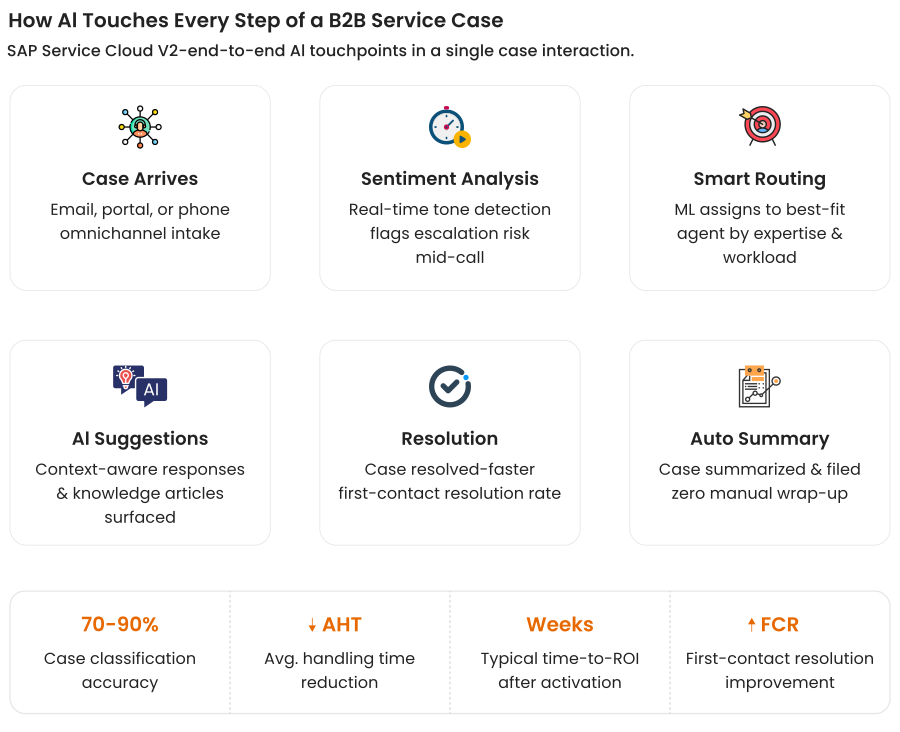
Based on publicly available implementation data and partner case studies, Service Cloud V2 presents the most defensible near-term ROI case for AI investment in the SAP CX portfolio. Five capabilities are generally available and have documented performance benchmarks:
Real-time sentiment analysis tracks emotional shifts within a conversation, not just overall tone at case close. For B2B accounts with high annual contract values, detecting escalation signals mid-interaction, before a customer asks to speak with a manager, has material retention implications.
ML-based case routing assigns incoming cases based on historical resolution patterns, agent expertise profiles, and current workload distribution. The result is fewer misrouted cases and faster time-to-resolution on the first assignment.
Generative productivity tools, including context-aware response suggestions, automatic case summarization, and knowledge article recommendations, collectively reduce average handling time. SAP's own data and partner implementations suggest measurable ramp-time reductions for new agents, though your results will depend on knowledge base quality and implementation depth.
The Digital Service Agent, when combined with the AI Shopping Assistant, enables a single conversational interface spanning product discovery through post-sale support, eliminating handoffs that currently create friction in B2B service models.
SAP Engagement Cloud (Formerly Emarsys) + Customer Data Platform
The Emarsys rebrand to SAP Engagement Cloud is more than cosmetic. It signals tighter integration into SAP's enterprise data layer, particularly the connection between CDP transactional data from S/4HANA and interaction data from Sales, Service, and Commerce.
A few developments worth tracking:
SAP Marketing Cloud is being retired. If you are on SAP Marketing Cloud, this requires a migration plan to Engagement Cloud. SAP continues to provide minor updates during the transition period, but new feature investment has shifted to Engagement Cloud.
SAP has been recognized as a Leader in the Gartner Magic Quadrant for Personalization Engines for the seventh consecutive year (as of the most recent publication).
New cross-platform SDK pilot unifies Android, iOS, and web integration for first-party data collection relevant for B2B organizations running mobile commerce or field sales applications that need to feed engagement data back into the CDP.
AI audience building and identity resolution capabilities in CDP are generally available and performing well in documented implementations. Predictive CLV is in active development and should be treated as a maturing capability rather than a production-ready feature.
The Platform Layer: BTP, WalkMe, and Loyalty
Two developments outside the core CX products have practical implications for B2B implementations:
WalkMe across CX applications: SAP completed its acquisition of WalkMe in 2024 for approximately $1.5 billion. WalkMe's in-application guidance is now available across CX products, providing contextual, role-specific walkthroughs within the application itself. For organizations rolling out new AI-powered workflows to teams accustomed to legacy systems, this reduces the gap between deployment and productive adoption, which is where most enterprise software ROI is lost.
SAP Customer Loyalty Management: New engagement models extend beyond traditional points-based programs. For B2B, "loyalty" operationalizes contract renewal rates, share-of-wallet expansion, and account retention. This module provides structured mechanics for those outcomes, though it requires integration with your commercial and service data to function at the account level.
A Phased Action Plan
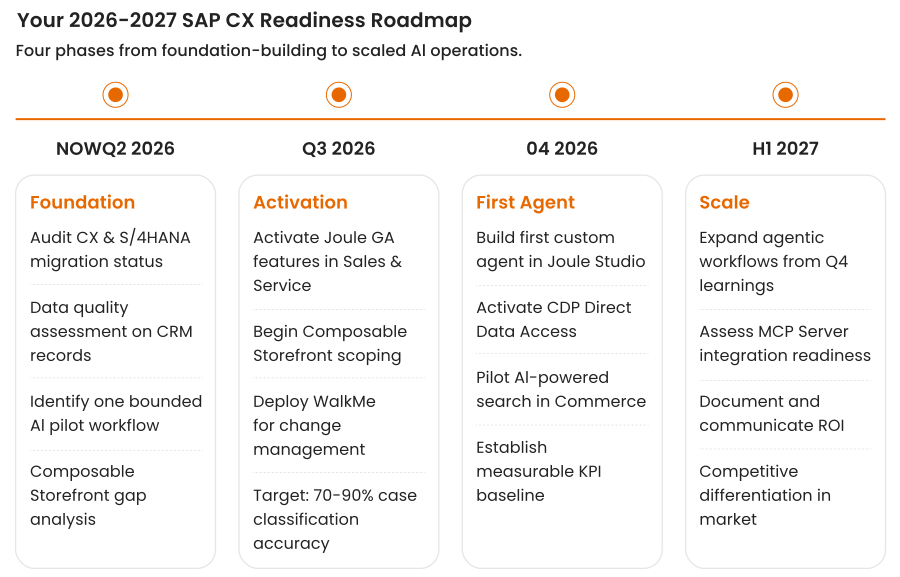
Roadmap analysis is only useful if it drives decisions. Here is a phased approach grounded in what is available now versus what is coming:
| When | Key Actions | Expected Outcomes |
|---|---|---|
| Now → Q2 2026 | Audit CX and S/4HANA migration status. Conduct a data quality assessment across CRM records (lead status, opportunity stages, activity history). Identify one bounded AI pilot workflow.Audit CX and S/4HANA migration status. Conduct a data quality assessment across CRM records (lead status, opportunity stages, activity history). Identify one bounded AI pilot workflow. | Clear gap analysis. Data readiness baseline. Stakeholder alignment on migration sequencing. |
| Q3 2026 | Activate Joule's core GA features in Sales and Service Cloud V2. Begin Composable Storefront scoping if currently on Accelerator storefronts. Deploy WalkMe for change management on any new rollouts. | Documented time savings per rep. 70–90% case classification accuracy (dependent on data quality). Adoption roadmap in place. |
| Q4 2026 | Build first custom agent in Joule Studio. Activate CDP Direct Data Access for unified account intelligence. Pilot AI-powered search in Commerce Cloud. | First agentic workflow in production. Unified view of account interactions across touchpoints. Measurable KPI baseline established. |
| H1 2027 | Expand agentic workflows based on Q4 learnings. Assess MCP Server integration readiness. Document and communicate ROI. | Scaled AI operations. Validated ROI case for executive stakeholders. Competitive differentiation from organizations still in foundation-building mode. |
| AI content generation for campaigns | Intelligent audience building in CDP | Cross-channel journey optimization |
Common Implementation Mistakes — and How to Avoid Them
Waiting for fully autonomous AI before starting. The features that are production-ready today, better summaries, smarter routing, faster data retrieval, are not glamorous, but they are measurable. Organizations that defer AI adoption until autonomous agents are fully mature will be building data foundations and change management muscle while competitors are already in their second or third iteration. Start with what works now.
Underinvesting in data quality. Every AI capability in this portfolio is constrained by the quality of your underlying data. Lead scoring requires consistent firmographic data and at minimum three to six months of normalized engagement history. Case classification accuracy improves with consistent categorization disciplines applied over time. Activating AI features on top of inconsistent data produces inconsistent results and erodes organizational confidence in the technology.
Planning CX modernization in isolation from ERP migration. A disconnected front office and back office creates exactly the friction your customers experience in your current state. CX investment decisions should be sequenced with S/4HANA migration planning, not treated as a separate workstream.
Designing processes around roadmap features. Don't redesign your sales or service organization around capabilities that are in preview or on the roadmap. Pilot one workflow against a defined hypothesis, measure outcomes over 60–90 days, and scale based on evidence.
Treating software deployment as a change management strategy. Technology without adoption delivers zero ROI. WalkMe, structured training programs, and visible executive sponsorship are not soft investments, they are the mechanism through which software investment converts to business outcomes.
Connect with our experts to discuss your SAP CX needs.