For IT and eCommerce leaders at manufacturers and distributors on SAP Commerce Cloud: the checks to run before Black Friday and the review to run after Cyber Monday.
Key takeaways
-
Black Friday is now a B2B event: 81% of B2B businesses take part, and 64% of sellers expect sales to grow.
-
B2B storefronts rarely break from traffic alone. Most peak trouble starts at the SAP ERP connection
-
SAP recommends peak dashboards and alerts at least three weeks out and surge notice at least three business days ahead.
-
The two weeks after Cyber Monday decide how calm next year's peak will be.
Your dealers don't care that Black Friday started as a consumer holiday. They care whether your site shows their contract price and real stock on the Monday they place year-end orders.
B2B Black Friday readiness is about that week. Plenty of load tests only cover guest pages, and plenty of SAP ERP price calls have never seen peak volume. When the storefront slows, the phones start ringing: in a 2025 survey, 75% of B2B buyers said they'd switch suppliers for a better online experience.
This guide starts three weeks out and runs through peak week to the review that follows it.
Short answer
B2B Black Friday readiness means your storefront and its connection to SAP ERP can handle peak orders without errors or delays. On SAP Commerce Cloud, that means load testing with logged-in buyers, protecting ERP calls with timeouts and fallbacks, freezing change early, and naming who responds to incidents.
Why B2B Black Friday readiness matters now
Black Friday and Cyber Monday used to be retail's problem. That's changed. DHL's 2026 Black Friday Trend Report found 81% of B2B e-commerce businesses take part in Black Friday, and 64% of e-commerce businesses expect their Black Friday sales to grow. Digital Commerce 360 reported that Cyber Monday is becoming its natural extension for distributors and equipment suppliers chasing year-end budgets.
For manufacturers and distributors, peak also means dealers stocking up for the new year and contractors spending what's left in their budgets. Retail customers reorder too, with NRF expecting November and December sales to grow 4.2%. Those orders land on the same storefront in the same week.
Your buyers also want to do more of it themselves. Gartner found that 61% of B2B buyers prefer a rep-free buying experience. When the site slows, they don't wait for a rep. They pick up the phone or go elsewhere.
Where do B2B storefronts break during peak?
Rarely where teams expect. A B2B storefront on SAP Commerce Cloud does far more work per page than a consumer site. Every logged-in buyer needs account-specific prices and stock, and checkout runs a credit check. Much of that comes from SAP S/4HANA or SAP ECC.
That's why a storefront can pass a load test and still struggle on Cyber Monday. Guest pages barely touch the ERP. A distributor's buyer with thousands of contract prices and a credit check at checkout is a much heavier workload, and in B2B it's the one that matters.
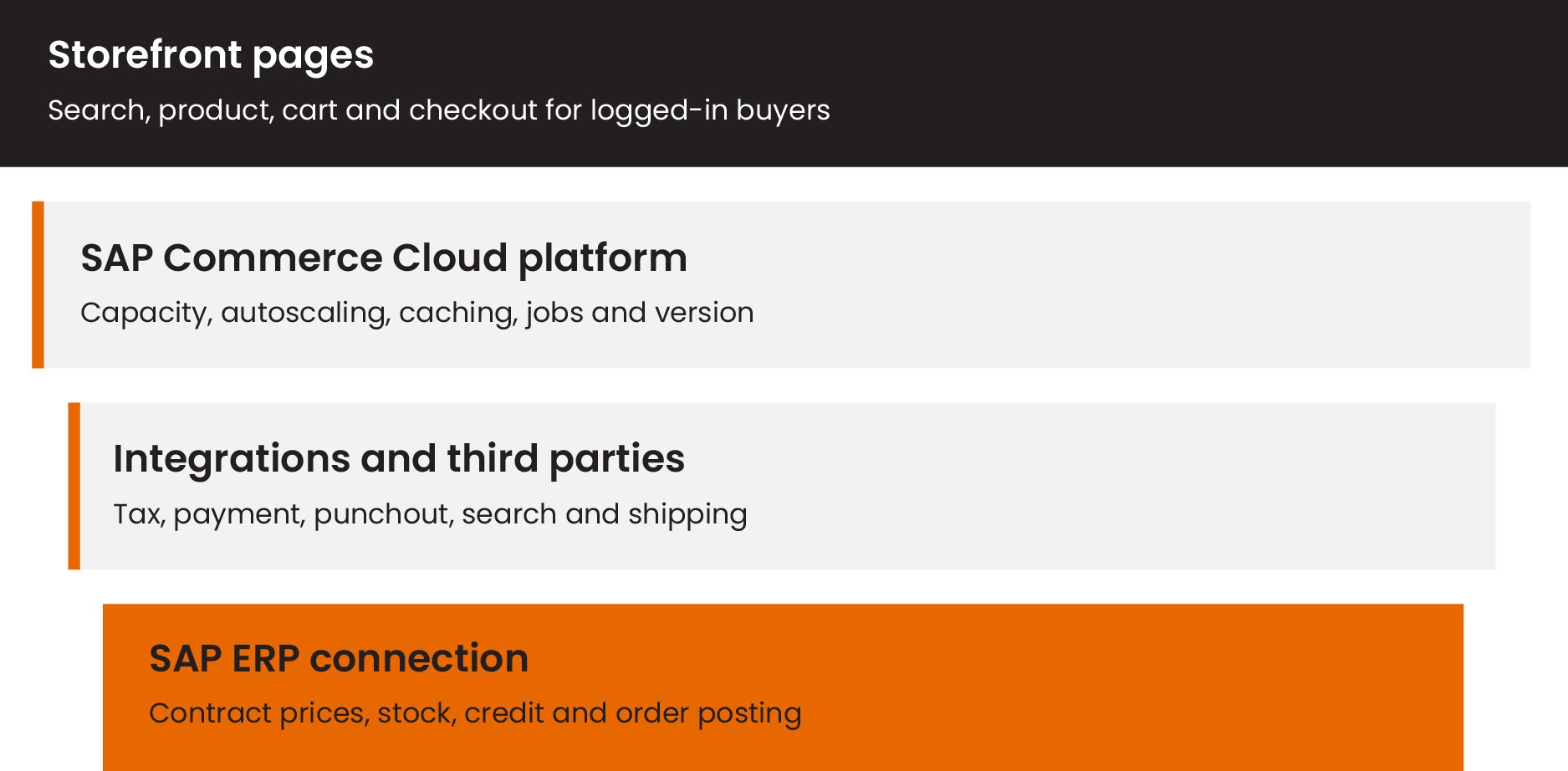
Where B2B peak incidents start. Knack Systems view based on SAP Commerce Cloud projects.
Read it from the bottom up. When ERP calls slow down, every page that shows a price slows with them. When order export queues, buyers notice only when confirmations and shipments arrive late. A fix that's ready after the freeze starts stays on the shelf all weekend.
From the field
In our experience, B2B storefronts rarely fall over from traffic alone. They stall at the ERP, where price and stock calls time out and order exports queue. Then the fix can't ship because the freeze has started.
Knack Systems SAP Commerce Cloud practice
What to check three weeks before Black Friday
Three weeks is enough to close the gaps that hurt most, if you pick them carefully. These are the checks we'd run first on SAP Commerce Cloud.
| Check | Why it matters | Typical owner |
|---|---|---|
| Load test with logged-in buyers and integrations on | Guest pages hide the ERP bottleneck | Commerce lead |
| Review autoscaling and capacity with SAP; pre-scale for known events | A configured maximum isn't capacity that's already running | Commerce lead + SAP |
| Notify SAP of peak dates by support ticket | SAP asks for at least three business days' notice | IT director |
| Timeouts and fallbacks on price and stock calls | Slow ERP calls shouldn't hang every page | Integration owner |
| Alert when order export to SAP ERP queues | Unposted orders delay confirmations and shipping | Integration owner |
| Move batch jobs and catalog syncs out of peak hours | Heavy jobs compete with buyers for resources | Commerce lead |
Priority checks three weeks out. Owners are typical; adjust to your team.
SAP's own Holiday Season Readiness Program guidance asks customers to run a full load test cycle and set up holiday dashboards and alerts at least three weeks before peak. It also asks for notice of surge events at least three business days ahead through a support ticket.
Check your version, too
SAP Commerce Cloud moved to JDK 21 and Spring 6 with the framework update, and security fixes for the JDK 17 version ran until the end of Q2 2026. If you're still behind, don't start the upgrade now. Do put it at the top of January's plan, because entering peak on an unsupported version narrows your options when something breaks.
Get the full Black Friday readiness checklist
25 checks across five stages for manufacturers and distributors on SAP Commerce Cloud, with scoring guidance. About 15 minutes.
How to run Thanksgiving week through Cyber Monday
Peak week is an operations event. The best ones are boring, and that's by design.
Peak runs on a timeline, not on heroics
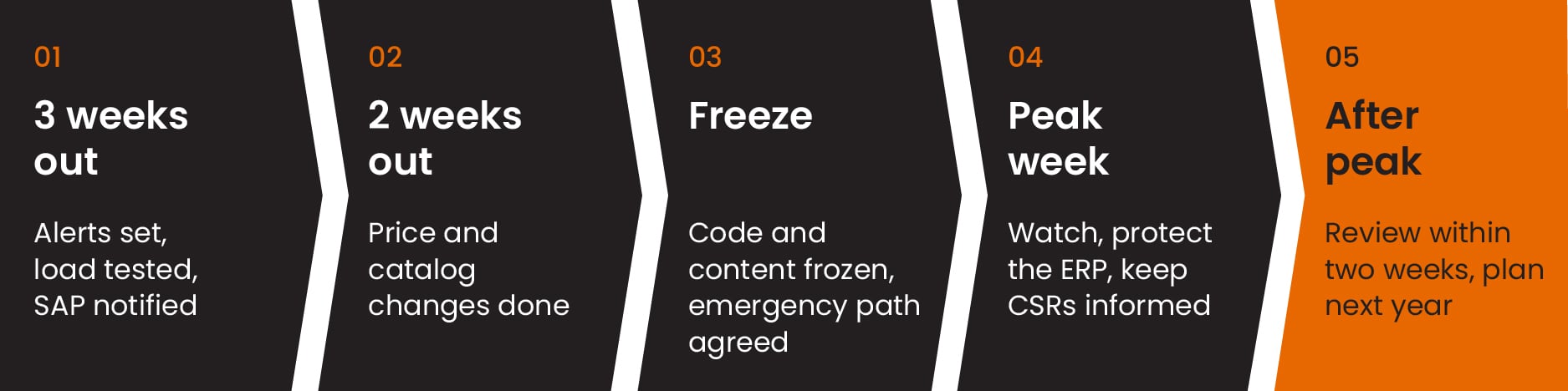
Indicative timeline for a late-November peak. Adjust to your promotions and release calendar.
Freeze early, with a way out
Agree a code and content freeze before Thanksgiving. Write down the emergency-change path, including who approves a fix and who deploys it. Without that path, a known bug stays live or a rushed fix breaks something else.
Know who picks up the phone
Name an on-call team from Thanksgiving through Cyber Monday. List escalation contacts at SAP and at every integration partner. Make sure the people on call are subscribed to SAP Cloud System Notification Subscription (CSNS), which SAP uses for important system notifications.
Give customer service live order status
Peak week brings "where's my order?" calls. Buyers forgive a delay they can see; they don't forgive silence. When an industrial manufacturer gave its CSRs and dealers real-time order visibility with Knack Brava and SAP Commerce Cloud, order inquiry calls fell 60%.
What does an hour of downtime cost a B2B seller?
More than most teams can say. ITIC's 2024 survey found that for over 90% of mid-size and large enterprises, one hour of downtime costs more than $300,000. The same research found six in 10 businesses can't calculate their own hourly cost.
When the storefront fails, buyers have options
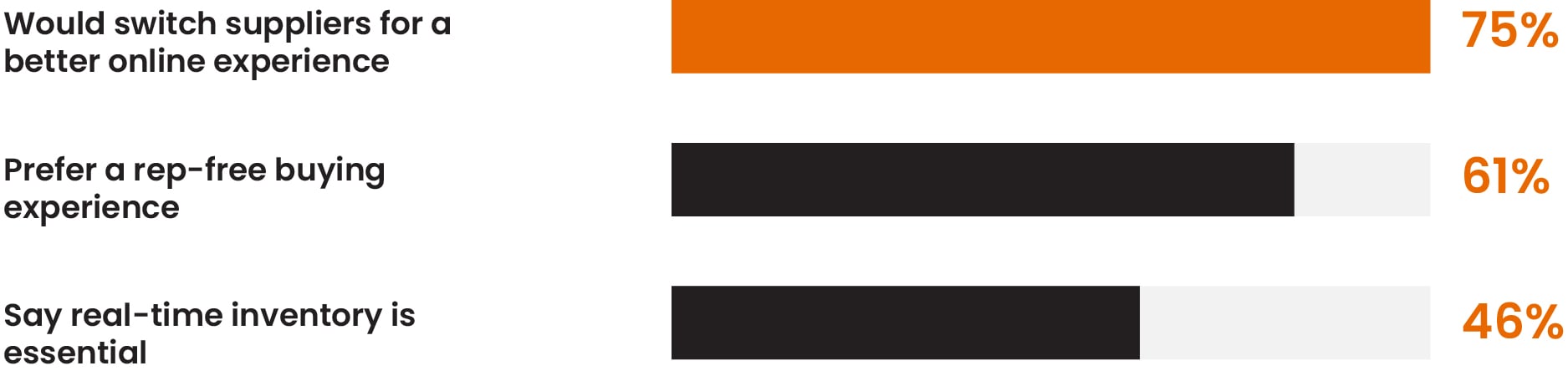
Bar chart: 75% of B2B buyers would switch suppliers for a better online experience; 61% prefer a rep-free buying experience; 46% say real-time inventory is essential
For a B2B seller, the cost runs past the orders lost in that hour. The dealer who places a year-end order with a competitor may stay there. That's why it's worth putting a number on your downtime before peak: it decides how much standby support and spare capacity make sense.
A rough estimate is enough to start. Take your average online order value on a peak day and multiply it by the orders you'd expect in an hour. Add the cost of the extra calls customer service would take. Put that number next to the cost of standby support for peak week, and the decision usually makes itself.
What to do in the two weeks after Cyber Monday
The post-peak review is where readiness stops being luck. Hold it within two weeks of Cyber Monday, while the near-misses are still fresh.
Start with what happened. List the incidents and the slow pages, plus every order that queued and every call that went to the wrong person. Then turn each finding into a backlog item with an owner and a date. Fixes that aren't scheduled by January rarely ship before November.
Next, decide how the storefront is supported for the rest of the year, with SLAs and proactive monitoring in place of a November scramble.
Why peak readiness is a year-round job
Teams that run the storefront like a product, with SLAs, proactive monitoring, a steady release rhythm and a roadmap, enter peak with nothing left to patch. Teams that treat it as a project enter peak with a backlog and a prayer.
Peak as a scramble vs peak as routine
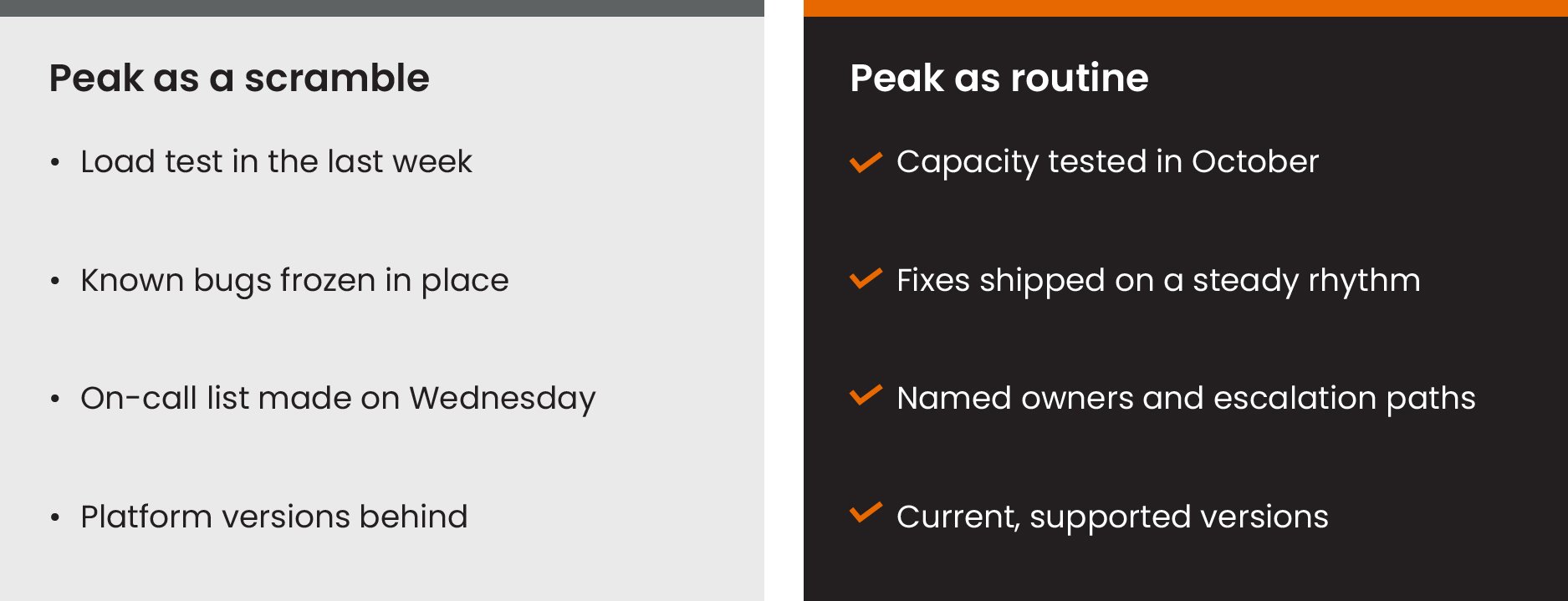
Knack Systems view, based on SAP Commerce Cloud projects.
A release rhythm is what makes the difference. A nutraceuticals and dietary supplements brand that connected SAP Commerce Cloud to SAP S/4HANA with Knack now ships releases 10x faster, and its order volume has grown 71%. Faster releases mean fixes land in weeks, not quarters. That's the core of SAP Commerce Cloud managed services done well.
Where to start
This week, count your gaps with the checklist and open the SAP ticket for your peak dates. Agree the freeze, with an emergency path, before Thanksgiving. In peak week, protect the SAP ERP connection and keep customer service supplied with live order status. By mid-December, run the post-peak review and decide how you'll support the storefront all year.
For more on the platform side, see our SAP Commerce Cloud performance optimization checklist.
Frequently asked questions
What is B2B Black Friday readiness?
B2B Black Friday readiness means your storefront and its connection to SAP ERP can handle peak-week orders without errors or delays, with a support team ready to respond. In practice, that means load testing with logged-in buyers and protecting price and stock calls. It also means freezing change early and naming an on-call team, then reviewing what happened after Cyber Monday.
Does Black Friday matter for B2B manufacturers and distributors?
Yes, increasingly. DHL’s 2026 Black Friday Trend Report found 81% of B2B e-commerce businesses take part in Black Friday, and 64% of e-commerce businesses expect Black Friday sales to grow. Even without promotions, dealer stocking and contractor budget spend often land in the same week, so B2B storefronts see real peak load.
What should I check on SAP Commerce Cloud before peak season?
Check that your version is current and supported, including the JDK 21 framework update. Load test with logged-in buyers and integrations active, and review autoscaling and capacity with SAP. Notify SAP of peak dates by support ticket at least three business days ahead, and test dashboards and alerts three weeks out.
Is it too late to prepare if Black Friday is three weeks away?
No, but prioritize. Three weeks is enough to set alerts and notify SAP. You can also add timeouts and fallbacks to ERP calls and move batch jobs out of peak hours. Agree the freeze and name the on-call team before Thanksgiving, and leave platform upgrades for January’s backlog.
Your busiest week shouldn't be your riskiest
Get 25 checks for B2B teams on SAP Commerce Cloud, from three weeks out to two weeks after Cyber Monday.
Get the checklistSources
